
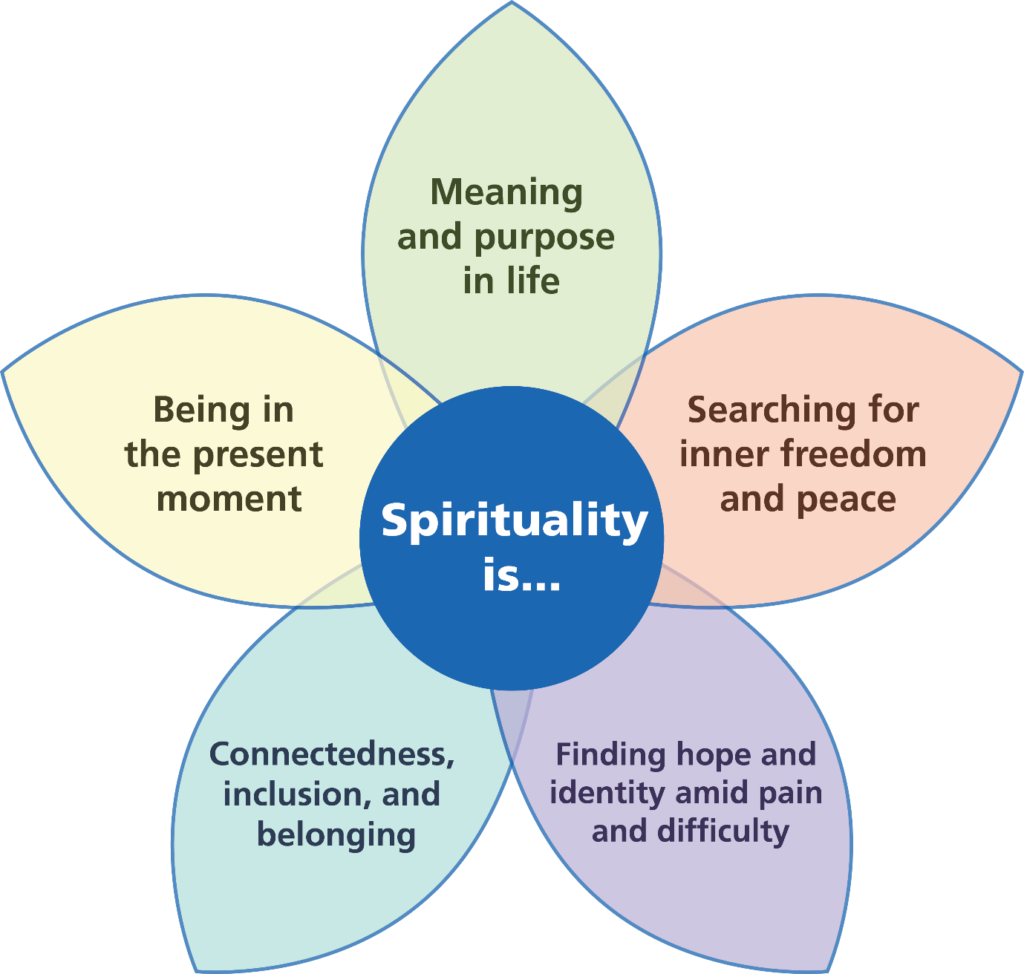
Trust patients and staff have designed our spirituality flower together. We hope it helps you, and us, understand your spiritual needs and concerns so we can better support you.
ur patients say that for them spirituality is not about a particular set of activities or interventions, but something which runs through the core of everything we need to consider in the care we provide.
What do we mean by ‘spirituality’?
Spirituality means different things to different people. It is helpful to understand the difference between religion and spirituality. People, whether they are religious or not, may have different spiritual needs at different times of their life. Spiritual needs and concerns include, but also go beyond, religious ones.
Why is spirituality important?
To be a human being is to be a spiritual being. Any care which is person-centred will attend to spirituality – even if, for some people, that is simply to confirm that they do not wish to discuss it.
Surveys carried out nationally and within our trust confirm that many service users wish to have spirituality considered within their care because it helps them to recover and keep well. Spirituality is at the very heart of the ‘recovery model’.
Evidence supports the importance of spirituality, belief and religion in understanding the causes of many mental health conditions, and the potential benefits of considering spiritual and religious factors within treatment planning.
The Human Rights Act 1998 and the Equality Act 2010 require us to make sure that patients are able to practice their religion or beliefs and are not discriminated against because of them.
How do we go about it?
Patients say that they would like people who work in mental health services to demonstrate the following qualities:
- ‘Start from where I am, not from where you think I am’
- Empathy (that means getting inside somebody’s world and understanding what it is like for them)
- Quality time (that doesn’t have to mean a lot of time, but does mean time without distractions)
- Attention to someone’s emotions, culture, identity and dignity
- Seeing someone as having strengths as well as needs
- ‘Working with’ rather than ‘doing to’ a person.
These qualities are especially important when we talk about spirituality, and we hope you will see these qualities in our staff.
What can I expect from TEWV services when it comes to spirituality?
- To have my spiritual or religious beliefs and practices respected as part of my resources to keep well.
- To have support for my spiritual or religious practices if I am in hospital or in the community.
- To be able to talk to staff about my spiritual needs or concerns and to have these included in my care plan.
- To have access to support from a chaplain if I wish to.
- To ensure that I am protected from ‘spiritual abuse’ (that can include having another person’s beliefs or practices forced upon me).
What resources are available?
There are three main resources within our trust to try and help ensure that your spiritual and religious needs are met.
- The Chaplaincy Team, who are available for spiritual, religious and pastoral care, both in hospital and in the community.
- The Spirituality Workbook. This is a resource which you can either work through on your own or with a member of staff. It will help you think a bit more about what ‘spirituality’ means and how it might be important to you. It is available through the Recovery College Online website.
- The Spirituality Flower. Working through the petals of the spirituality flower and some of the questions below may help you to explore your own spirituality and spiritual needs in more depth.
Exploring the petals of the spirituality flower
If you wish, your care team can use the spirituality flower with you to explore your spiritual or religious needs. We hope this will help staff find out your spiritual or religious beliefs and practices, so they can support you and help you to feel comfortable. The spirituality flower has recently been updated based on feedback from our patients, service users and staff. The updated flower attempts to be more inclusive and has clearer language to reflect how we talk today about spirituality and belief.
If at any stage in your care you feel it would be helpful to go into some of these themes or questions on the spirituality flower in more depth, then you might want to consider some of the questions that go along with each petal of the flower below.
It might be enough simply to think about some of these questions by yourself, but you might also find it helpful to discuss them with a member of staff, or with one of the chaplains. Please remember, it is absolutely your choice to decide which of these questions are relevant to you at the moment. You do not need to answer all of them, but instead focus on the ones that are important to you right now.
Meaning and purpose in life
- What is most important to you in life right now?
- What do you believe in?
- Is there a specific aim that is important to you at the moment?
- Would you describe yourself as a spiritual, religious, or something else?
- Do your beliefs or values affect the care you would like to receive from our trust?
Searching for inner freedom and peace
- Where do you find hope, strength, or comfort?
- Is there anything that helps you feel alive, happy, or peaceful?
- What is there in your life that gives you internal support?
- has being ill made any difference to any of these?
Finding hope and identity amid pain and difficulty
- When you are really upset where do you turn for help?
- What keeps you going when life is difficult?
- Is your current situation affecting your ability to practice your spirituality?
Connectedness, inclusion, and belonging
- How do you get on with other people? Where do you feel a sense of belonging?
- Is there anything you would like to change about your relationships?
- Are you part of a spiritual, religious or belief community – if so, are they supportive of you?
- How do you connect to nature and the world around you?
- Do you believe in a god or higher power? If so, what kind of relationship do you
Being present in the moment
- How much time do you spend going over the past or worrying about the future?
- When do you notice that you are alive?
- Do you have any personal spiritual or religious beliefs or practices that ground you in the present? What are they, do they help, is there anything we can do to support them?
- What other activities help you to feel focused on the here and now?
What happens next?
After thinking or talking about some of these questions, you might decide that there are some actions you want to take to help support your spiritual wellbeing.
These might include:
- Using the spirituality flower to explore your spirituality and spiritual needs in greater depth: a member of staff will be able to help you to do this if you wish.
- Exploring religious practice: you may wish to attend worship or prayers; you may need resources such as scriptures, a prayer mat or a rosary or to ensure that your religious dietary requirements are catered for.
- Exploring non-religious spiritual practice: people, whether they are religious or not, may experience spiritual benefit in such things as walking and exercise, having access to nature, creative activities such as art, music, cookery or gardening or practising mindfulness.
- Referral to the chaplaincy service: Trust chaplains are available to talk to anybody about anything and offer support to service users both in hospital and in the community. Chaplains may be from any faith and are recognised and authorised by their faith and belief communities to offer this kind of care.
They are not just there for religious people and will never try to impose their own beliefs or morality on you. You can trust a chaplain to listen to you and not to judge you.
- Making contact with a local faith group: you may wish to find out about a particular faith, to begin practising it, or to resume a practice which has been important to you in the past by making contact with a local faith community.
- Making contact with a local activity group: It may be that there are local groups which can help you to get involved in some of the non-religious activities mentioned above. Some people also find spiritual benefit in getting involved in some voluntary work.
Seeking further support
There are clinicians of all disciplines around our trust who have particular experience in this field.
If you would like some further advice or support from one of these, please email [email protected]
Other resources
Trust resources
Recovery College Online: Course in ‘Spirituality and Recovery’
Recovery College Online: Spirituality Workbook
Rethink: Spirituality, Religion and Mental Illness
Royal College of Psychiatrists Spirituality Special Interest Group
The Network for Pastoral, Spiritual and Religious Care in Health
L742, V8, 14/08/2025 (archive: 13/08/2028)