
Monday 30 March 2026
A new clinical trial is underway at a York hospital, aiming to determine if an experimental drug can help slow down the progression of early Alzheimer’s disease.
Foss Park Hospital in York is one of eight sites in the UK to be a part of a global study involving around 800 adults worldwide.
The research team at the hospital has recruited their first participant into the study.
They are hoping to recruit a further three participants, who have recently been diagnosed with or showing signs of mild cognitive impairment or mild dementia due to Alzheimer’s disease. They may experience frequent memory loss or struggle to remember everyday details.
The first participant received their initial course of treatment in January, with more people expected to join the study in the coming months.
Monica Metson, from Harrogate, is the first participant recruited and received the treatment with support from her husband Mick, who said: “Our motivation was two-fold. One was personal, having some hope, rather than Alzheimer’s disease coming at you like a train.
“The other was for future generations, to help. So whatever they learn from this trial, be it positive or negative, it will benefit people further down the line.”
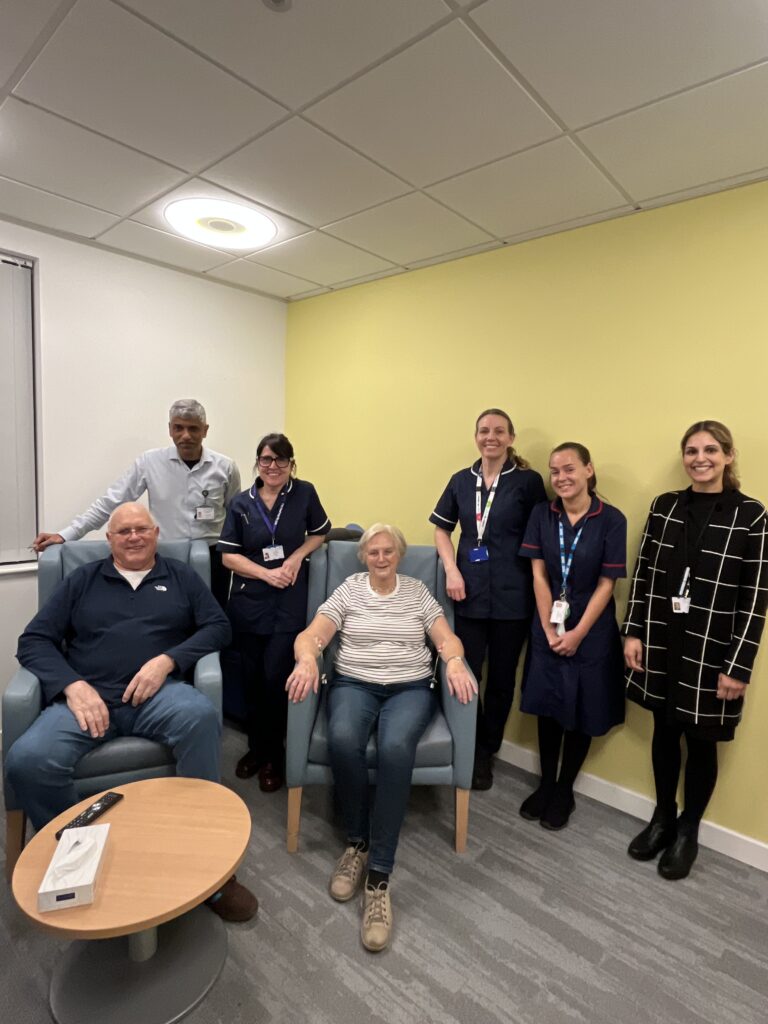
Our Foss Park research team has worked closely with a range of partner organisations on the study. This includes the National Institute for Health and Care Research (NIHR), University of York, The Leeds Teaching Hospitals NHS Trust and York and Scarborough Teaching Hospitals NHS Foundation Trust.
Each intravenous treatment session lasts between two and four hours. Once treatment has started, the participant will be in the study for 72 weeks, with regular MRI scans to track progress.
Sarah Daniel, head of research at our trust, said: “This has been a collaborative effort, using the expertise from many teams to bring this trial to fruition.
“We’re passionate to provide research opportunities for people closer to where they live. Previously, people would need to travel out of our region for a trial of this nature, so we’re very proud that York is selected as one of the sites of the study – opening up opportunities for people with mild dementia closer to their homes.
“This is one of many studies underway to try to prevent or slow the progression of dementia, and it’s encouraging to see our trust playing a key role in this vital research.
“Our first participant was identified from Join Dementia Research – a national research register where volunteers can join to indicate their willingness to take part in dementia research. We encourage people living with dementia and healthy volunteers to sign up so they can also help future research in this area.”
Chris Speed, Operations Director at the NIHR North East and North Cumbria Regional Research Delivery Network, said: “This research is important both for people with dementia and for those close to them.
“The study will help improve our understanding of the causes of dementia, develop effective treatments and improve care. We’re pleased to be working with the team at Foss Park Hospital to deliver this important study and for giving people in the region the chance to take part.”
We are looking to recruit a total of four people into this study and recruitment will close once the international target of 800 has been met.