
Dr Sarah Hambleton, consultant clinical psychologist, and Becky Hughes, clinical nurse specialist, both work in the neurodiversity team in our children and young people’s mental health service at Orca House in York.
They deliver autism screening and assessments to young people between the ages of five and 18, as well as overseeing the day-to-day organisation and planning of the service.
They feature in the latest edition of Healthwatch York’s magazine, giving insight into their roles, what a normal day looks like for their team, and revealing more around what happens during an autism assessment.
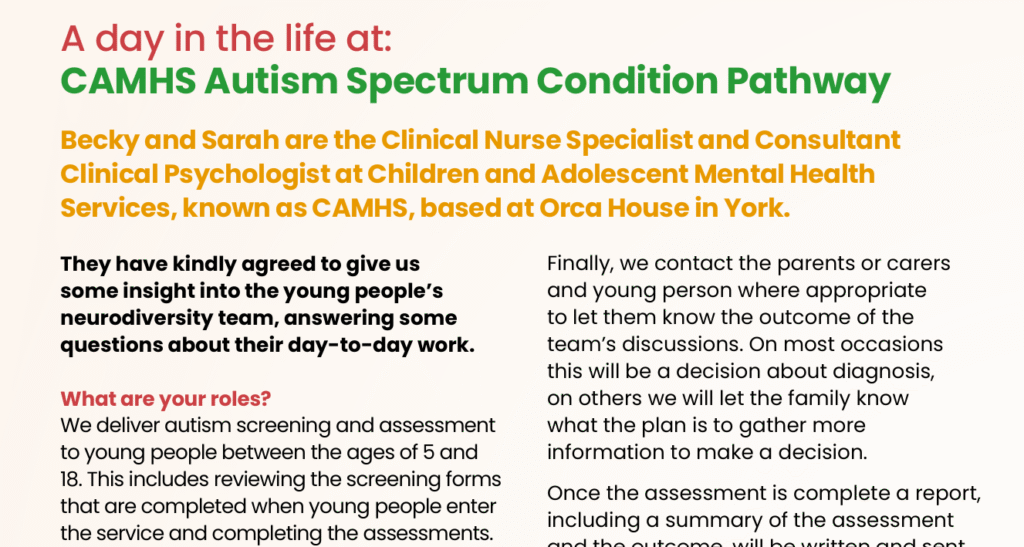
Read an excerpt below and read the full article, A day in the life at: CAMHS Autism Spectrum Condition Pathway on Healthwatch York’s website. The article is on pages 4-6.
Can you tell us about a ‘normal’ day?
A typical day in our autism assessment clinic starts at 9am with a discussion about the assessments we have planned for the day. We then start the assessments, which look for social communication difficulties within children and adolescents to determine if they display traits of an Autism Spectrum Condition. These assessments are called Autism Diagnostic Observation Schedule appointments, often referred to as “ADOS”.
What happens at an assessment?
It takes a full day to complete an autism assessment. There are three parts: the child-based assessment, parental discussion and feedback.
We start with an age-appropriate play-based assessment, referred to as ADOS-2. This uses a combination of informal questions and play tasks to determine social communication differences. This may involve questions around emotions and friendships, informal chat about interests and some play tasks such as a storybook or puzzle.
During the assessment, we try to make every child feel as comfortable as possible and do not put any pressure on them to complete the tasks in a certain timeframe.
What is the best part of your job?
Being able to help young people and families find answers to questions they may have had for some time.